CBSE students answer five papers in their board exams. These are what we call “Core Subjects” At Walnut, we prepare them with a unique, proven approach for each subject — supported by our co-curricular program that sharpens reading, analysis and communication. These are all very unique aspects of Walnut and that is why we have students who consistently perform ahead of their peers. Scroll down for a quick overview of the core subjects.
Systematic Academic Program
Systematic Academic Program
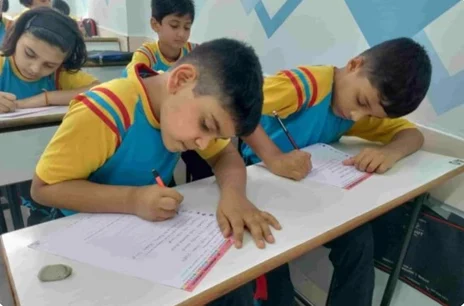
To ensure every student excels, Walnut has a structured system:
- Advanced Academics: With co-curriculars building sharper thinking, students advance almost a year ahead of peers. Read more.
- Differential Teaching (Std. 6–10): Students grouped as fast learners, regular pace and extra support. Regrouping after every unit ensures every child reaches their true potential. Read more.
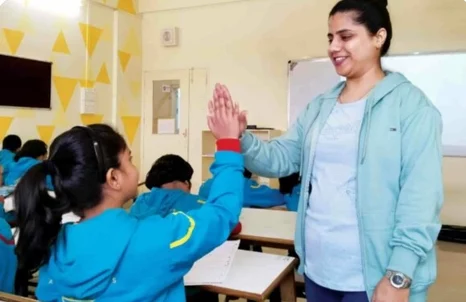
- Bridge Programs: Special support for new admissions to catch up.
- PEP teaching: Performance enhancement plans (PEP) for students needing help in subjects that are usually found harder to understand, such as Mathematics. These happen on Saturday mornings in the online format. Read more.

“My daughter is studying in Grade 6. I am very satisfied with the way the school has designed their curriculum keeping in mind the academics, sports and other co-curricular activities for the over all development of the child. The portion is divided into smaller units. That makes it easier for the child to study without stress. The Walmiki app gives lots of practice tests which the child can attempt. Very important point is transparency of the school with parents in all ways. That is a big add on.”
Shraddha Rege
Wakad Campus

“All the school faculty and the staff is well organized and aligned with academics. They have developed own learning system which looks innovative. I’m impressed with their innovative ideas and focused dedication; that keeps interest of kids vibrant and alive.”
Prajakta Girme
Fursungi Campus

“Walnut has an excellent learning system. The pattern which they follow is perfectly designed for kids, so they don’t feel any type of burden of studies. The learning experience is fantastic. The teachers are very friendly and positively active with students. The teachers really give their best and their approach favours concept based learning rather than rote learning, which will help the students in future for their concept development. The worksheets are amazing and keeps the interest levels high in studying. The teaching methodology and customized classrooms as per subjects are quite effective for students. I am fully satisfied with the content they teach to students at every level.”
Anitt Kumar Maurya
Fursungi Campus
English
English is very important as it is not just a subject. It is the first language and it is also the medium of instruction. And now with AI, it’s also the new programming language.
If students are weak in English, it affects their performance everywhere! At Walnut, we give extra attention to English, as it is not our mother tongue. We have a brilliant approach to how we teach students to express themselves through speech, writing as well as thinking proficiently in English.
Mathematics
An essential subject in all aspects of life, at Walnut, Mathematics is taken to the next level. Mathematics involves constant problem-solving and at Walnut, teachers give students time to solve problems themselves and present the solution later, so they can learn from their mistakes and improve problem-solving skills. This approach differs from the typical method of just copying down solutions from the board. Again, in the age of AI, we can authoritatively say that our systematic program meets all the needs of building strong foundational Mathematics skills.
Science
It is important for every human being to develop a scientific mindset. Walnut students have an extra edge on this front too. To remain curious, get hands-on exposure to a variety of concepts and be able to apply it correctly is extremely important. At Walnut, we don’t just talk – we act. Through multiple activities, correct sequencing and simplified content, we are able to get students excited about Science – and that is exactly what we want, right?
Social Studies
Social Studies is a subject that most students usually have a problem about and the only memories that even we as adults have are rote learning, long answers and incredibly long and boring lessons. But at Walnut School, it is not so. We have great lessons and even more amazing discussions. How do we do all this?
Third Language : Sanskrit
Our Sanskrit program is designed to help students score very well in the subject through clear concept building and structured practice. Students learn grammar patterns, vocabulary, and sentence structures in a systematic manner that closely aligns with the exam pattern. With the help of focused worksheets and guided practice, students become comfortable with the language and are able to approach the exams confidently and score high marks.
Hindi
We take a very practical approach and largely focus on their communication skills. Students enjoy the class and get a good feel of the language. They do not get burdened and do not spend time doing random assignments and lessons. The exams are also quite straightforward and are easily handled by the students.
Differential Teaching
- Mixed sections regrouped → All divisions of a grade are restructured into new groups based on ability and aptitude in each subject.
- Same concepts, different approach → Every group studies the same syllabus, but the teaching style and pace and depth are adapted.
- Balanced classrooms → The range between the fastest and slowest in each group is reduced, making lesson plans more effective.
- Personalized progress → Fast learners are challenged, regular students move steadily and slower learners get targeted support — without feeling intimidated.