Part of a Comprehensive Math System
- 5 to 7 classes per week for formal instruction. Read more about this here.
- Concept Preview Lab:1 to 3 classes per week for conceptual preparation.
- Strategic Pre-exposure: Concept Preview Lab concepts taught BEFORE formal Core Math lessons.
The Competitive Reality
Walnut sets math at REAL expected difficulty levels, monitoring Std 5 & 8 scholarship papers, Std 10 board papers, and competitive exams. Questions have become more twisted over time, involving multiple concepts – we prepare students for this reality, not fake comfort.
Concept Preview Methodology
- Fast-paced processing – many problems, whole class participates.
- Zero calculations – pure conceptual understanding and problem setup.
- Pre-exposure advantage – students see concepts before formal lessons.
- Multiple problem types – extensive practice in mathematical thinking.
Differential Grouping
Based on student aptitude, same concepts taught but with different complexity levels to match individual grasping ability.

The Neuroplasticity Advantage
When students practice mathematical thinking repeatedly, neurons create stronger connections, making complex problem-solving automatic. This is why consistent Concept Preview Lab practice transforms mathematical ability.
REAL EXAMPLES WITH PROGRESSION
Example 1 : Std. 6 – Parallelograms
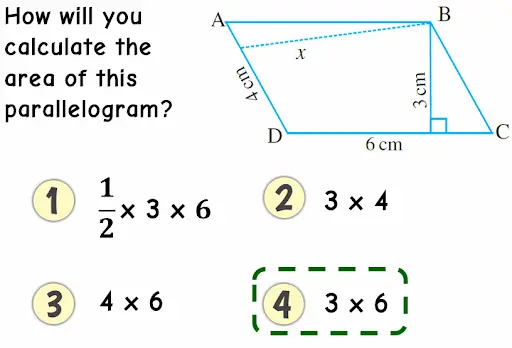
Students see a problem asking “How will you calculate the area of this parallelogram?” with multiple choice options. They must identify the correct setup
(3 × 6) without actually calculating. This requires understanding:
- Parallelogram area formula (base × height).
- Which measurements represent base and height.
- Why other options are wrong.
THE INSIGHT The real challenge isn’t multiplication, it’s knowing WHY to multiply these specific numbers. Once students understand the “why,” calculations become secondary.
Example 2 : Std. 7 – Direct Proportion
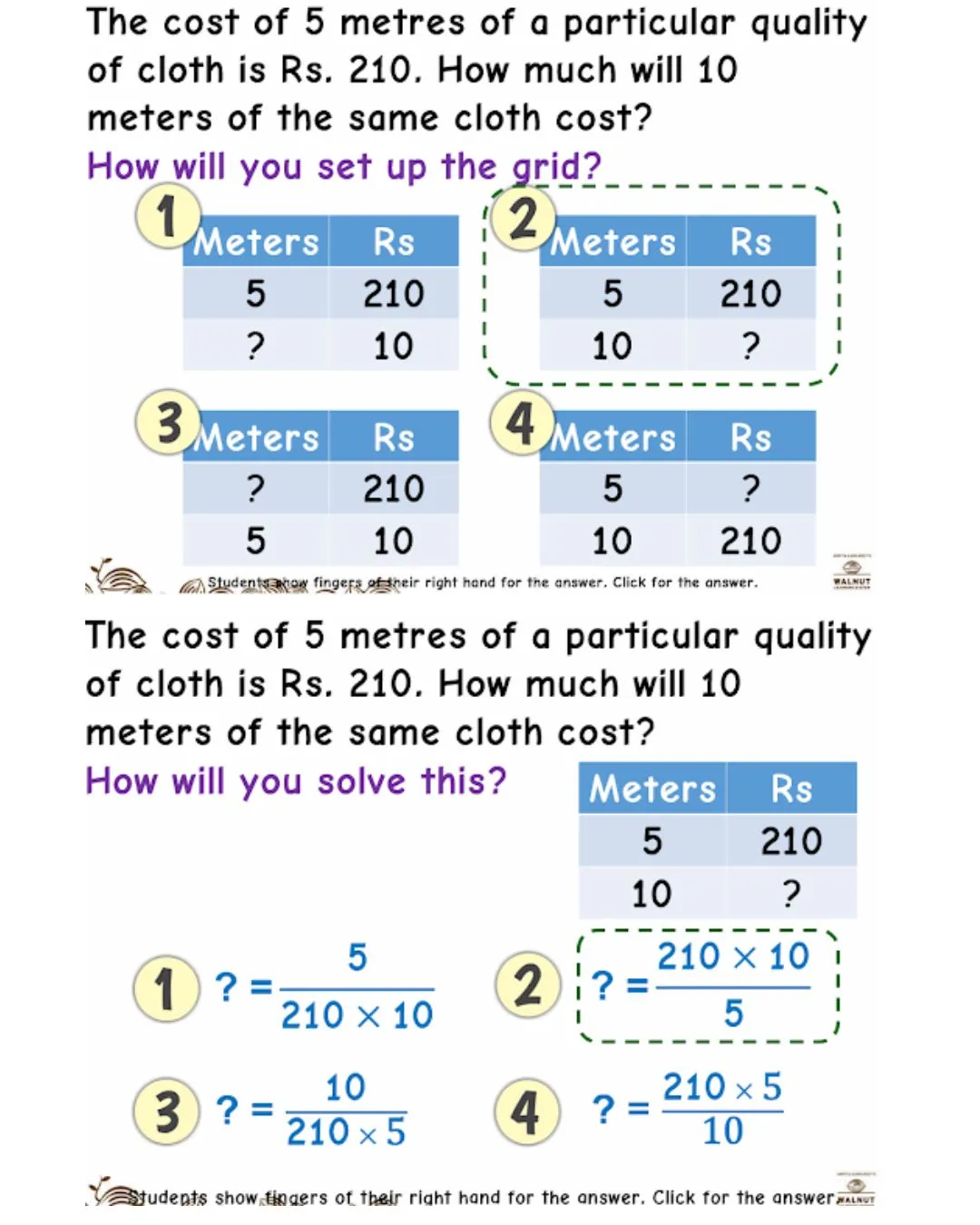
Students see: “5 meters of cloth costs Rs. 210. How much will 10 meters cost?”
STEP 1: Information Organization “How will you set up the grid?” Students must understand what information goes where before they can solve anything. They need to recognize that meters and rupees are the two variables, and which values are given vs. unknown.
STEP 2: Solution Setup “How will you solve this?” Only after organizing the information do they choose the mathematical approach. They must understand why it’s (210 × 10)/5 and not one of the other setups.
The Power of This Approach
When students practice many problems like this – just the thinking and setup without calculation – they develop mathematical intuition. By the time they reach the actual solving class, they’re not struggling with “What do I do?” but simply executing calculations they already understand.
The Systematic Approach
Concept Preview Lab → Core Math → Try-a-Tests → Practice Tests → Unit Tests Each stage builds on the previous, with students already familiar with concepts when they encounter formal instruction.
Preparation for Success
- Government scholarship exams (Std 5 & 8).
- Board examinations with ease.
- Competitive exam readiness.
- Strong mathematical foundations for higher education.