Every child’s academic journey is unique, and the right educational approach depends on their learning needs and goals. While a structured academic calendar offers regular assessments and scheduled board examinations, some students may benefit from greater flexibility due to health-related circumstances, subject-specific preparation needs or personal preferences.
The National Institute of Open Schooling (NIOS) offers this flexibility through its On-Demand Examination (ODE) system, which allows eligible learners to choose when to appear for examinations, subject to NIOS rules and availability. Understanding how ODE works, its eligibility criteria and applicable guidelines can help parents make informed educational decisions.

What is the NIOS on-demand examination?
The NIOS On-Demand Examination (ODE) is an examination facility offered by the National Institute of Open Schooling (NIOS) that allows eligible students to choose when to appear for their exams, based on their preparation and subject availability. The On-Demand Examination (ODE) allows eligible students to appear for a subject examination at a designated examination centre when they feel fully prepared.
How does the ODE work?
The On-Demand Examination (ODE) follows a computer-based question paper generation system. When a student registers for an exam, the system prepares a question paper from a pre-developed question bank, following a defined subject blueprint and examination pattern.
Students must appear at designated NIOS ODE exam centres, which are typically located at NIOS Regional Centres or selected Kendriya Vidyalayas. Availability varies by region, so checking slot and centre options early is advisable.
- Computer-generated question papers: Each question paper is generated from a pre-developed question bank according to the prescribed syllabus and examination pattern. Although the questions may vary across papers, they follow the same subject requirements and assessment standards.
- The process: The question paper generation process is designed to uphold examination integrity and ensure that assessments remain aligned with the prescribed academic and evaluation framework.
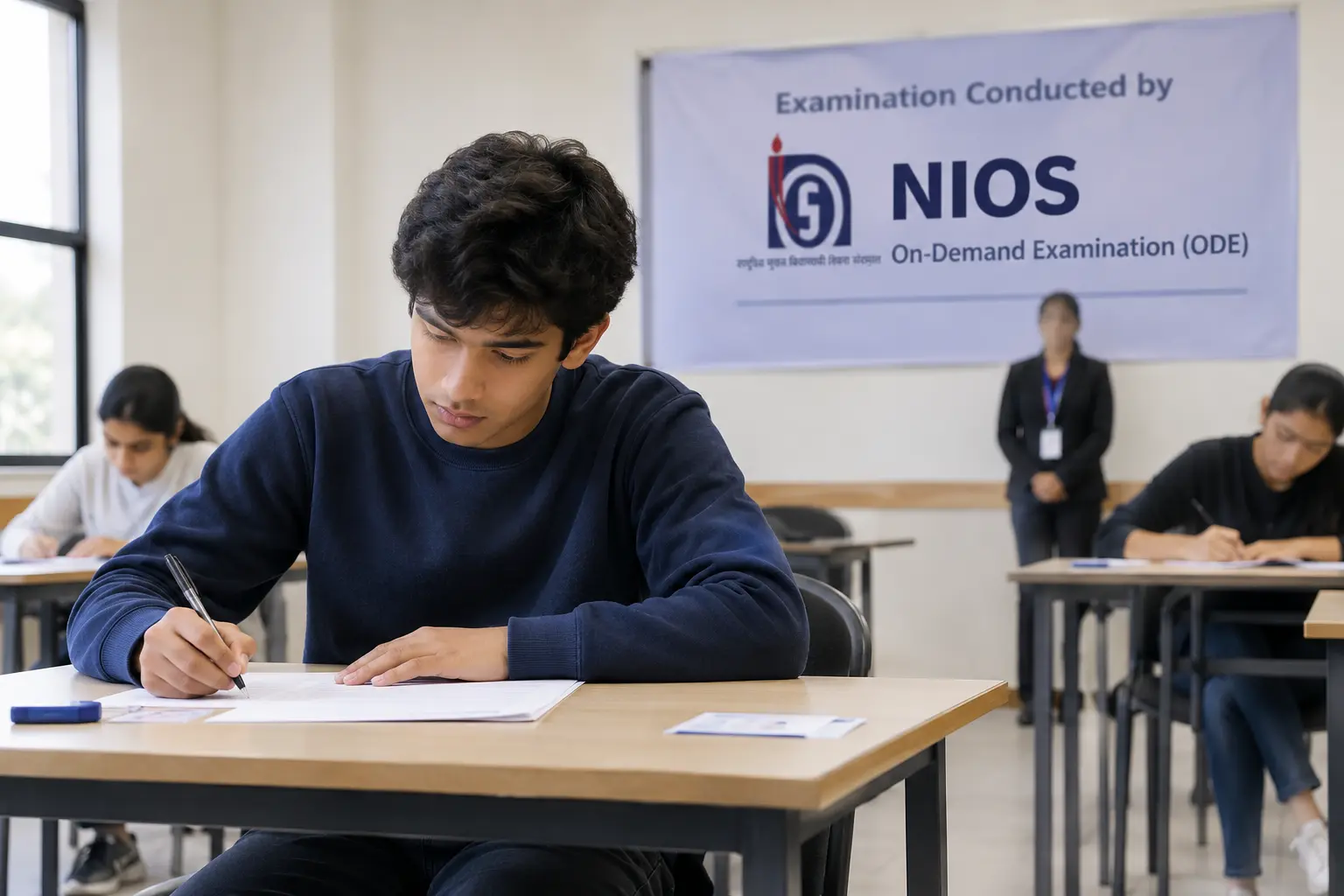
NIOS ODE eligibility
NIOS ODE for Class 10 and Class 12 is available through different admission streams, each with its own set of eligibility requirements. The examination is available to eligible students registered with NIOS, as well as students from other recognised boards who meet specific admission requirements. The applicable stream depends on the student’s previous academic qualifications and examination status.
- Existing NIOS students (Stream 1): Students enrolled in NIOS can apply for ODE after the first public examination. They can choose to appear for their registered subjects through ODE, depending on subject and examination-centre availability.
- Students applying for Class 10 (Stream 3): Students who have already passed Class 10 and wish to update their qualification or who appeared for a recognised board’s examination but could not clear it, or were eligible but could not appear, may also qualify under the applicable NIOS requirements.
- Students applying for Class 12 (Stream 4): Students who have already passed Class 12 or an equivalent higher qualification and wish to improve or update their marks in up to four subjects, as well as those who appeared for a recognised board’s examination but did not pass or were eligible to appear but could not do so, may qualify, subject to the applicable NIOS admission criteria.
NIOS ODE results
NIOS follows an established process for declaring results and issuing academic documents. Here is the detailed breakdown of result processing, marksheet issuance and re-evaluation rules based on official NIOS guidelines:
- Result declaration: NIOS generally declares the examination results in the last week of the month following the examination, subject to the completion of the evaluation process. For instance, results for examinations conducted in July are generally declared by the last week of August.
- Marksheet and certificate dispatch: For students who pass all required subjects, NIOS automatically processes and prints the marksheets and certificates. These documents are sent to the respective NIOS Regional Centre, where students can collect them or receive them by post.
- Rechecking and re-evaluation: Students may apply for rechecking or re-evaluation of their answer scripts, as permitted under NIOS guidelines. Applications must be submitted using the prescribed form available on the official NIOS website.
Pros and cons of NIOS
While the NIOS On-Demand Examination system can provide valuable support for students, it also has certain advantages and practical limitations. Before making any decision, parents should weigh the real pros and cons of NIOS; not just the flexibility.
✓ What works
- Scheduling & timelines: Offers complete freedom to select exam dates based on individual readiness and personal comfort; respects student sovereignty.
- Academic progression: Provides eligible students with opportunities to appear for examinations according to NIOS guidelines.
- Learning methodology: Allows students to plan their subject preparation according to their individual learning pace.
- Flexibility vs. integrity: Dynamic computerised paper generation ensures low malpractice while supporting young athletes, artists or medical recovery.
✗ What to watch out for
- Scheduling & timelines: Lacks fixed deadlines, creating a high risk of procrastination, missed targets and delayed academic progress.
- Academic progression: Examination dates, result declarations and certification timelines require careful planning, particularly when coordinating with further admissions.
- Learning methodology: Relies entirely on isolated self-study without daily teacher instruction, feedback or peer group learning.
- Flexibility vs. integrity: Limited test centres (Regional NIOS / Kendriya Vidyalayas) require travel and advance planning.
NIOS vs CBSE: how on-demand exams compare with the regular school routine
The NIOS vs CBSE question comes down to one thing: does your child need flexibility or do they perform better inside a fixed structure with daily teacher contact?
NIOS on-demand examination (ODE)
- Exam scheduling & dates: Offers eligible students flexibility in choosing examination dates, subject to NIOS guidelines, available slots and designated examination centre schedules.
- Learning & assessment pacing: Allows students to prepare for individual subjects and appear for examinations according to their readiness and available slots.
- Instruction & preparation mode: Independent self-study through printed learning materials or private coaching/tutoring. There is no teacher-led daily classroom interaction.
- Continuous evaluation & feedback: Evaluation happens solely through the end-of-unit test paper with no continuous tracking between attempts.
- Peer dynamics & collaborative learning: Individual study in isolation. Students do not have classmates, group study sessions or peer discussion environments.
CBSE school examination
- Exam scheduling & dates: Follows a structured academic calendar, with scheduled school assessments and CBSE board examinations. Students can prepare according to planned exam dates and revision schedules.
- Learning & assessment pacing: Follows a planned academic schedule in which subjects progress throughout the school year, supported by regular lessons, assignments and assessments.
- Instruction & preparation mode: Provides classroom-based teaching, regular interaction with teachers and opportunities to clarify doubts and receive academic guidance.
- Continuous evaluation & feedback: School assessments, assignments, classroom activities and periodic tests help teachers monitor students’ progress and identify areas requiring additional support.
- Peer dynamics & collaborative learning: Rich peer interaction provides regular opportunities for classroom discussions, group projects, collaborative activities and interaction with classmates as part of everyday school life.
Is NIOS ODE the right choice for your child?
Choosing the right educational pathway depends on a child’s learning preferences, academic needs and long-term goals. The On-Demand Examination (ODE) system may suit students who benefit from flexible examination schedules and can manage their preparation independently. Parents should consider their child’s ability to maintain a consistent study routine, their need for academic guidance and the importance of classroom interaction, regular teacher feedback and collaborative learning.
For children who thrive on routine, teacher encouragement and peer interaction, open schooling can feel isolating. A regular school environment offers a structured academic calendar, daily teacher interaction and opportunities for social and collaborative learning.
Understanding these differences can help parents choose an educational pathway that aligns with their child’s individual needs and future aspirations.

Which schooling route may suit your child?
Consider NIOS / on-demand examination (ODE) if:
- Flexible learning needs: Students pursuing professional sports training, national-level athletics or performing arts may benefit from examination flexibility when their commitments make regular school attendance challenging.
- Medical or health conditions: Students recovering from a prolonged illness, surgery or a health condition that affects consistent classroom attendance may benefit from a more flexible educational arrangement.
Choose regular CBSE schooling if:
- Daily structure & healthy habits: If the child thrives best when provided with a clear, predictable daily timetable, structured classroom routines and balanced exposure to academics, physical play and creative arts.
- Learning style: If a student learns most effectively through live teacher explanations, group discussions, peer collaboration and hands-on practical activities rather than reading printed modules alone.
- Personality & social growth: You value all-round character development, including building strong communication skills, computational thinking, athletic endurance and lifelong friendships within a safe, supportive community across our Shivane, Wakad and Fursungi campuses.
CBSE schooling in Pune: Walnut School
If you’re looking for a CBSE school in Pune that balances academic rigour with genuine stress-free learning, Walnut School’s approach is built around exactly that. While flexible systems like NIOS ODE offer a safety net when needed, our regular CBSE framework across our Pune campuses in Shivane, Wakad and Fursungi focuses on preventing academic stress before it ever starts:
- No School Bag: Books and study materials remain at school, allowing students to engage in organised classroom learning without the need to carry heavy school bags.
- Built-in planning & tracking: Our unique learning management system breaks down subjects into clear, manageable daily units so students master concepts progressively without needing last-minute re-examinations.
- Well-rounded development: From computational thinking to sports, theatre and public speaking, children build strong academic habits alongside lifelong social skills within a warm, supportive school community.

Frequently asked questions
Yes. NIOS is a recognised national board under the Ministry of Education, Government of India. Its certificates and mark sheets are legally valid for higher education admissions in Indian universities, competitive exams like JEE and NEET and government employment.
Yes. Students from CBSE or other recognised boards can improve marks through NIOS by registering under Stream 3 (Class 10) or Stream 4 (Class 12) to appear for subjects they wish to clear or upgrade.
A student can register for up to 4 subjects under Stream 3 or Stream 4 through ODE, depending on subject and seat availability at the chosen exam centre.
Yes. Students can transfer from NIOS to CBSE school provided they meet the standard admission eligibility requirements for the respective standard. At Walnut School, we evaluate each transfer application individually to ensure a smooth transition into our structured academic environment.
Connect with us
Ready to see Walnut School first-hand? Reach out to us through any of these channels:
Visit our campuses
Experience our facilities at:
Start your child’s journey towards excellence today. Explore Walnut School CBSE admissions 2027-28 and schedule a campus visit to learn more.